
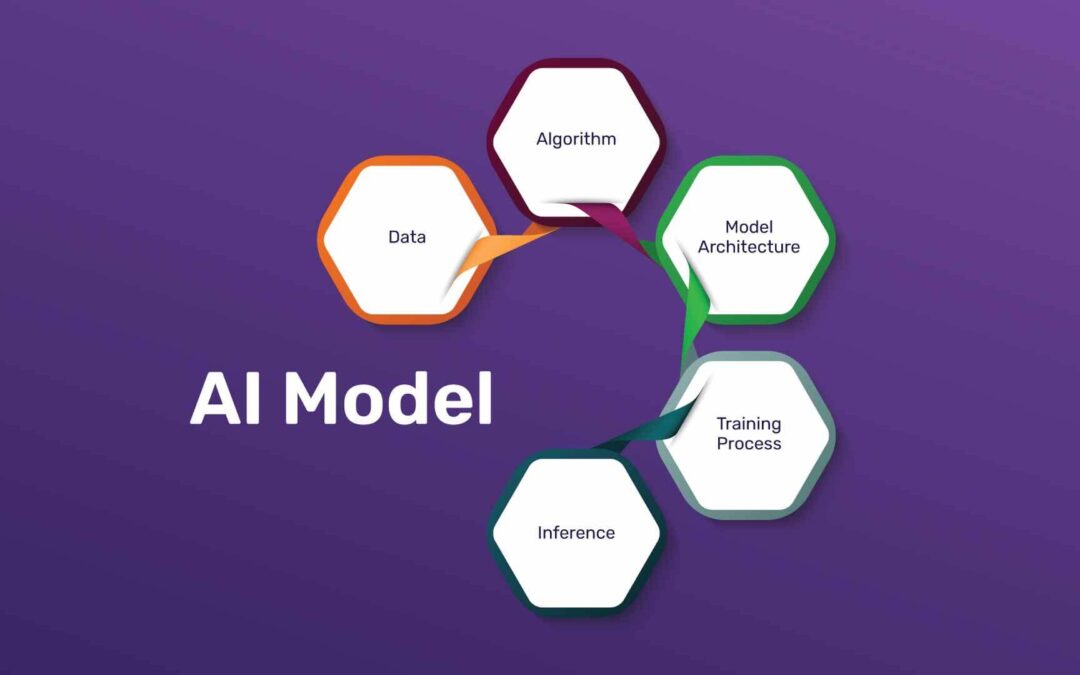
Artificial Intelligence (AI) models power everything from virtual assistants to autonomous vehicles. But how do they actually work? In this article, we’ll break down the fundamental concepts behind AI models, their learning process, and the foundational knowledge required to implement one.
1. The Core Components of an AI Model
At its essence, an AI model mimics human decision-making by analyzing data, identifying patterns, and making predictions. The key components include:
- Data: The foundation of any AI model. Data can be structured (e.g., databases) or unstructured (e.g., images, text, videos).
- Algorithms: These are the mathematical formulas and logic that help the model process data and make decisions.
- Training Process: AI models learn from past data using supervised, unsupervised, or reinforcement learning techniques.
- Evaluation & Testing: Once trained, a model is tested on new data to measure accuracy and effectiveness.
- Deployment: After successful training, AI models are integrated into applications for real-world use.
2. How AI Models Learn
AI models don’t start out intelligent—they learn through experience, just like humans. The learning process typically follows these steps:
- Data Collection: Gathering relevant and high-quality data is crucial for effective learning.
- Preprocessing & Feature Selection: Data is cleaned, formatted, and important features are identified.
- Training: The model learns from labeled (supervised learning) or unlabeled (unsupervised learning) data.
- Optimization: The model refines its learning by adjusting parameters and reducing errors.
- Validation & Testing: Performance is assessed using a separate dataset to avoid over-fitting (unexplained under performance syndrome).
3. Basic Knowledge Set Needed to Build an AI Model
To implement an AI model, one should have a foundational understanding of:
- Mathematics & Statistics: Concepts like probability, linear algebra, and calculus help in understanding model algorithms.
- Programming: Languages like Python and R are commonly used for AI model development.
- Machine Learning Basics: Knowing how different learning techniques work (e.g., neural networks, decision trees, clustering) is essential.
- Data Handling: Skills in data cleaning, preprocessing, and feature engineering are necessary.
- Model Evaluation: Understanding accuracy, precision, recall, and other metrics helps in refining models.
4. Ethical Considerations in AI Development
As AI models become more integrated into daily life, ethical concerns arise, including:
- Bias in Data: AI models can inherit human biases if trained on unbalanced data.
- Transparency & Explainability: AI decisions should be understandable and justifiable.
- Privacy & Security: Data privacy laws must be adhered to when developing AI models.
Conclusion
Building an AI model requires a combination of data, algorithms, and structured learning processes. While technical expertise enhances AI development, understanding the theoretical framework behind AI is essential for anyone looking to explore this field. Whether you’re a researcher, developer, or enthusiast, grasping these fundamental concepts is the first step toward leveraging AI effectively.
Recent Comments